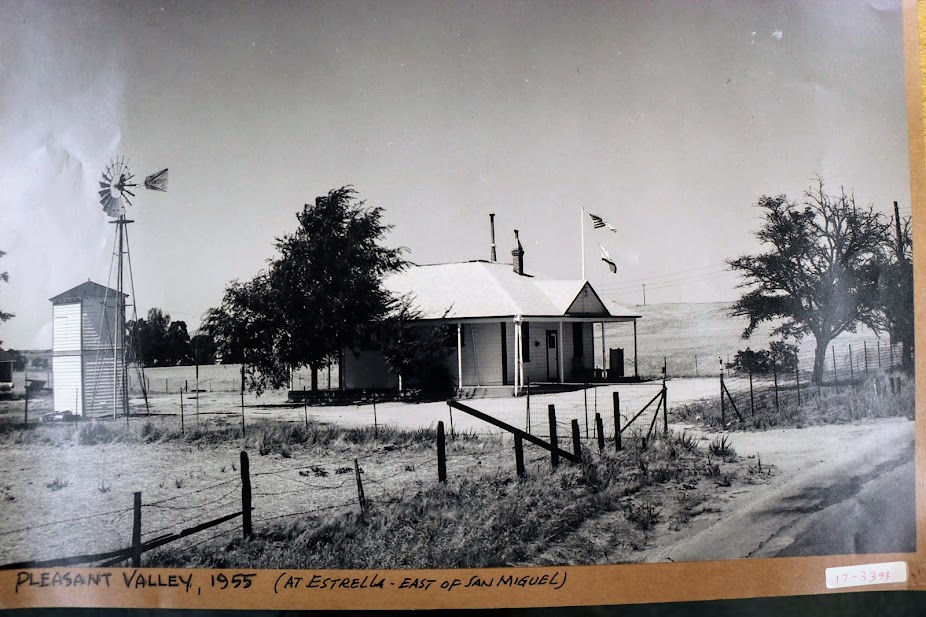
Before sprawling campuses, school buses, and paved country roads connected North County, education in the Paso Robles area looked very different. Across the rolling hills and ranchlands, one-room schoolhouses once stood as the heart of rural communities, ensuring that even the children of isolated farming families had access to an education.
In her introduction to the 2004 book "Readin' 'Ritin' 'Rithmetic," published by the El Paso de Robles Area Pioneer Museum, project coordinator Milene F. Radford paints a vivid picture of those early schools. "On a knoll, in a flat, by a creek, in a canyon or in a grove of oak trees," she writes, one-room schoolhouses dotted the countryside in every direction from Paso Robles.
The earliest classrooms were often little more than brush shelters built beneath sprawling oak trees. The trees provided welcome shade, while brush walls kept wandering cattle and livestock away from students. Other schools began in unused ranch buildings or lean-tos attached to family homes. As more settlers arrived, neighbors pooled their resources, donating lumber, labor, and time to construct permanent schoolhouses by hand — long before electricity or power tools made the work easier.
Life was difficult for early homesteaders. Families struggled to establish their ranches and farms with limited resources, yet they remained committed to giving their children an education. Parents petitioned the San Luis Obispo County Board of Supervisors to establish school districts and, in many cases, even paid the first three months of a teacher's salary themselves. School terms were often split into fall and spring sessions of three or four months each, sometimes with different teachers leading each term.
A single teacher was responsible for educating students from first through eighth grade in one classroom. While younger children practiced their letters and arithmetic, older students worked on history, geography, grammar, and advanced mathematics. Learning required patience, independence, and cooperation, as students often worked quietly while the teacher instructed another grade level.
The schoolhouse quickly became much more than a place for lessons. In many rural communities, it was the first public building ever constructed. Church services, community meetings, holiday celebrations, elections, spelling bees, and Christmas programs all took place within its walls. For isolated ranching families, the school served as the social center of the neighborhood.
The number of rural school districts grew rapidly as settlement expanded. Between 1870 and 1910, larger districts were divided to accommodate growing populations, eventually reaching 94 districts countywide by 1918. Ironically, improvements in roads and transportation later reversed that trend, as many small districts consolidated into larger ones. Today, Pleasant Valley School remains the county's only original school district from that era.
Some rural schools actually predated Paso Robles' own first school, established in 1877. Schools such as Nacimiento (1869), San Miguel (1871), Estrella (1873), Josephine (1873), Summit (1873), Las Tablas (1874), and Highland (1874) served scattered settlements long before the city became an educational hub.
Although only a handful of these schoolhouses — such as Adelaida and Geneseo — still stand today, their legacy lives on. Through preserved buildings, historic photographs, and the memories of former students, they remind us that education in North County was built not by large institutions, but by determined neighbors who believed every child deserved the opportunity to learn.